
When we think of extraordinary wildlife encounters, the Masai Mara is often the first destination that comes to mind.
And for good reason. It’s iconic, it’s unforgettable, and spotting Africa’s Big Five is on the bucket list of countless wildlife lovers.
But what if your next wildlife adventure took you somewhere unexpected?
Across India, Nepal, Bhutan and Sri Lanka, an entirely different world of wildlife awaits. Think searching Himalayan forests for a red panda, sailing into the Indian Ocean in search of blue whales, or scanning Ladakh’s rugged mountains for a snow leopard.
And that’s only the beginning. From tigers and Asiatic lions to wild elephants, sloth bears and the mighty Indian gaur, South Asia offers encounters shaped by extraordinary landscapes and diverse ecosystems.
Here, the wild isn't always found on a safari drive. Sometimes, you track it through a forest, wait for it in the mountains, or venture out into the open ocean.
So, if you're planning to explore South Asia, here are ten unforgettable wildlife encounters to add to your journey.
1. Wildlife Safari in India

Let’s start with the one everyone thinks of when you say wildlife in India.
The tiger.
India currently has 58 tiger reserves across 18 states, so there is far more to Indian tiger country than one famous national park. From the dry forests and lakes of Ranthambore to the forests of Kanha and Bandhavgarh, each landscape offers a very different way of experiencing the wild.
But here is what makes an Indian safari interesting: you are not simply going to see a tiger. You are going to look for one.
A safari can begin with almost nothing. Your naturalist spots a pugmark on the track. Langurs begin calling from the trees. A herd of chital suddenly becomes alert. The vehicle slows down, everyone starts looking in the same direction, and for a few minutes, the entire forest feels like a puzzle you are trying to solve.
For an international traveller familiar with the open savannahs of East Africa, an Indian tiger safari can feel distinctly different. Many of India’s tiger reserves feature a mosaic of deciduous forest, grassland and dense undergrowth, where wildlife can emerge into view and disappear back into cover within moments.
And that uncertainty is part of the experience.
The tiger may be the headline, but it is hardly the only reason to enter the forest. Depending on the reserve, you could encounter leopards, sloth bears, gaur, sambar, chital, wild dogs, langurs and an extraordinary variety of birds. Ranthambore, for example, is home to tigers alongside leopard, sloth bear, hyena, nilgai, sambar and chital.
How Many Days Should You Stay?
If the tiger is your main objective, we would recommend at least 3 nights, giving you multiple safari opportunities rather than putting all your hopes on a single game drive.
And for an international traveller, those extra days matter. They give you time to understand the rhythm of the forest rather than simply ticking “tiger safari” off the itinerary.
At a glance:
Signature species: Bengal tiger
Other wildlife: Leopard, sloth bear, gaur, sambar, chital, wild dog and numerous bird species
Recommended stay: 3 nights or more
Best period: The main safari season varies by reserve. Many parks offer good wildlife-viewing opportunities between October and June, subject to local opening dates and conditions.
Experience: Guided jeep safaris with naturalists and local forest guides
What makes it different: Tracking, patience and reading the forest rather than simply driving through it
Because sometimes the most memorable part of an Indian safari is not the moment the tiger appears.
It is everything that happens while you are looking for it.
Want to experience India beyond its landmarks? From tiger country to lesser-known wildlife landscapes, our journeys are designed to take you closer to the India that exists beyond the usual itinerary.
2. Red Panda in Nepal & Bhutan: The Himalayan Search

Forget the big cats for a moment.
Somewhere high in the forests of the Eastern Himalayas, there is a much smaller animal that is considerably harder to find — the red panda.
And if your idea of wildlife travel is chasing rare sightings rather than ticking off famous animals, this might be one of the most rewarding experiences you can add to a Nepal or Bhutan itinerary.
Red pandas inhabit the temperate and subalpine forests of the Eastern Himalayas, including parts of Nepal and Bhutan. Bamboo-rich undergrowth and mature trees provide the habitat they need to survive.
Which means this is not exactly a “drive up and spot one” kind of wildlife experience.
You trek.
You slow down.
You look into trees.
And then you look again.
Red pandas are solitary, elusive and spend much of their time in trees, making them particularly difficult to spot even when you are in the right habitat. Their diet is largely made up of bamboo, and their preferred forests contain the dense vegetation and mature trees they need to survive.
For an international traveller, that changes the entire rhythm of the experience. Instead of a safari vehicle moving from one sighting to another, a red panda expedition can involve forest walks, local trackers, patient observation and long stretches of simply listening to the landscape.
And when you finally spot that flash of rust-coloured fur between the branches, it feels less like something you were shown and more like something you discovered.
Where and When?
Nepal's eastern Himalayan landscapes, including areas around Ilam and the Kangchenjunga region, are important red panda habitats. In Bhutan, the species has been recorded across several protected areas, including Jigme Dorji, Jigme Singye Wangchuck and Phrumsengla national parks.
A dedicated 3–5 day wildlife experience gives travellers a more realistic amount of time for tracking rather than relying on a single walk or drive. Sightings are never guaranteed — and that is important to understand when planning the experience.
At a glance:
Signature species: Red panda
Altitude: Temperate and subalpine forests of the Eastern Himalayas
Recommended stay: 3–5 days for a dedicated red panda experience
Best period: Spring and autumn are commonly favoured for trekking and wildlife observation, with local conditions varying by region
Possible additional wildlife: Himalayan black bear, leopard, barking deer, Himalayan goral, serow and diverse Himalayan birdlife
Experience: Guided forest walks, tracking and patient wildlife observation
The red panda is classified as Endangered, with habitat loss and fragmentation among its major threats. That makes responsible wildlife tourism particularly important: the goal is not to get as close as possible, but to experience the animal without disturbing the forest it depends on.
And perhaps that is what makes this encounter so special.
You don't conquer the Himalayas looking for a red panda. You simply slow down enough to notice one.
Looking for wildlife experiences that reward patience? Discover journeys through Nepal and Bhutan where the forest, the mountains and the search itself become part of the story.
3. Blue Whale Expedition in Sri Lanka: Into the Open Ocean

Imagine sharing the open ocean with the largest animal ever known to have lived on Earth. Off Sri Lanka's coast, that extraordinary possibility draws travellers out to sea.
Sri Lanka's waters support blue whales, sperm whales and several species of dolphins. Sri Lanka's whale-watching waters are particularly known around Dondra Point, Mirissa and Trincomalee.
And that changes the experience completely.
Instead of following tracks through a forest, you head out into the Indian Ocean, often early in the morning, watching the horizon for the smallest sign of movement. A splash. A dorsal fin. A sudden column of breath.
And then, if you're lucky, the ocean rises.
The blue whale is the largest animal on Earth, and seeing one in the wild is less about a guaranteed sighting and more about being in the right place at the right time. Around Mirissa, blue whales can be found alongside sperm, Bryde's and fin whales, as well as bottlenose, common and spinner dolphins.
For an international traveller, this is one of those wildlife experiences where the journey itself becomes part of the story. You leave the harbour, the coastline gradually disappears behind you, and suddenly there is nothing around you but open water.
The scale is difficult to comprehend until you see it.
When Should You Go?
The season depends on which coast you are visiting. On the southern coast around Mirissa, whale watching generally runs December to March, and off Trincomalee from March to July.
The east coast, including Trincomalee, follows a different seasonal pattern.
A typical whale-watching trip from Mirissa takes around 3–4 hours, although the duration can vary with sea conditions.
And while the blue whale is the obvious prize, it isn't the only encounter you could have. Depending on the location and conditions, the same expedition may bring sightings of sperm whales, Bryde's whales, fin whales and dolphins.
At a glance:
Signature species: Blue whale
Other possible encounters: Sperm whale, Bryde's whale, fin whale and dolphins
Main locations: Mirissa/Dondra Point and Trincomalee
Southern coast season: Generally November–April
Typical excursion: Around 3–4 hours from Mirissa
Experience: Open-ocean whale-watching expedition
Ideal for: Travellers looking for a marine wildlife experience beyond a conventional safari
There is one thing worth remembering, though: responsible whale watching matters. Sri Lanka regulates marine mammal observation through its Sea Mammals (Observation, Regulation and Control) Regulations, No. 1 of 2012 , which cover operator licensing and vessel safety.
Because sometimes the most extraordinary wildlife encounter is not the one where you get closest.
It is the one that reminds you just how small you are.
Want to experience Sri Lanka from a different perspective? Step beyond the island’s landscapes and into the waters that make its wildlife story just as remarkable.
4. Greater One-Horned Rhinoceros in India & Nepal: Into the Grasslands

If tigers invite you to search the forest, the greater one-horned rhinoceros offers a different kind of encounter.
In India's Kaziranga National Park and Nepal's Chitwan National Park, vast grasslands, wetlands and riverine forests create ideal habitats for these prehistoric-looking giants. Once pushed close to extinction, the species has made a remarkable recovery through conservation, with Kaziranga supporting the world's largest population. Kaziranga's UNESCO World Heritage listing reflects the global significance of this ecosystem.
On a guided safari, you might spot a rhino emerging through tall grass, grazing beside a waterhole or cooling off in a muddy pool. Both parks offer opportunities to encounter rhinos alongside other wildlife, including tigers, elephants and diverse birdlife. Nepal's Chitwan National Park is also a UNESCO World Heritage Site.
How Many Days Do You Need?
Allow 2–3 days per destination for multiple safari opportunities. In India, the main viewing season in Kaziranga generally runs from November to April; in Nepal, Chitwan is best visited from October to March, according to the respective tourism authorities (Assam Tourism and Nepal Tourism Board).
At a glance:
Signature species: Greater one-horned rhinoceros
Primary destinations: Kaziranga National Park, India; Chitwan National Park, Nepal
Recommended stay: 2–3 days per destination
Best period: November–April in India; October–March in Nepal
Other wildlife: Tigers, Asian elephants, wild water buffaloes and diverse birdlife
Experience: Guided jeep safaris through grasslands, wetlands and forests
Ideal for: Travellers seeking close encounters with one of South Asia's most iconic mammals
What makes this encounter special is the chance to witness a conservation success story in two different countries. You don't just see a rhino; you experience the landscapes that helped bring it back.
Want to take your wildlife journey beyond India’s tiger trails? Head east to Assam, where grasslands, wetlands and one of Asia’s great conservation stories come together.
5. Snow Leopard in Ladakh: Searching Above 3,500 Metres
Some wildlife encounters ask you to drive through a forest.
This one asks you to climb into the mountains and wait.
The snow leopard is one of the most elusive big cats in the world, and Ladakh is one of the most important places in India to look for it. The latest official assessment estimates 718 snow leopards across India, with around 477 in Ladakh, giving the region the country's largest estimated population.
And this is not a wildlife experience you casually add between sightseeing stops in Leh.
Leh sits at around 3,500 metres, while snow-leopard tracking takes travellers into considerably higher and colder terrain. Much of the experience centres around Hemis National Park, where travellers search vast mountain valleys with the help of experienced local trackers. In fact, Hemis National Park in Ladakh has been highlighted by Condé Nast Traveler as one of India's challenging destinations for spotting the elusive snow leopard.
And then comes the waiting.
A local tracker scans a distant ridge. Someone spots movement through binoculars. You stop. You wait. Nothing.
Then, perhaps, a pale shape moves across a rocky slope.
For an international traveller, this is expedition-style wildlife rather than a conventional safari. Snow leopard tours in Ladakh traditionally operate through the winter months, with the official Ladakh wildlife-tour guidelines identifying November to April as the main season for snow-leopard sightings.
The conditions are part of the experience too. Winter temperatures can be severe, the terrain is remote, and the animal's camouflage is so effective that even experienced spotters can spend hours scanning a mountainside before finding one.
How Long Should You Stay?
Give yourself at least 7 days for the dedicated wildlife experience, particularly if the snow leopard is the main reason for travelling. Sightings are never guaranteed, and the combination of high altitude, winter weather and remote terrain means patience is very much part of the itinerary.
Acclimatisation matters too. You are not simply arriving in Leh and immediately heading into the mountains. Giving yourself time to adjust to the altitude is an important part of planning a high-altitude wildlife trip.
And while everyone arrives hoping for the snow leopard, Ladakh has plenty more to reveal. The region supports blue sheep, Himalayan ibex, Tibetan wild ass, Tibetan wolf, red fox, Pallas's cat and a remarkable range of high-altitude birds.
At a glance:
Signature species: Snow leopard
Altitude: Leh is around 3,500m; tracking areas are generally higher
Recommended stay: 7 days for a dedicated snow-leopard experience
Best season: November–April
Other wildlife: Blue sheep, Himalayan ibex, Tibetan wolf, red fox, Pallas's cat and high-altitude birds
Experience: Winter tracking, long-range observation and guided wildlife walks/drives
Ideal for: Experienced wildlife travellers and international guests looking for a rare, expedition-style encounter
And there is something wonderfully fitting about ending a South Asian wildlife journey here.
You don't chase the snow leopard.
You don't call it closer.
You wait for the mountain to reveal it.
6. Asiatic Lion in India: Tracking the King of the Wild

In the dry forests of Gir, you enter the only place in the world where Asiatic lions survive in the wild. Once pushed close to extinction, these lions have made a remarkable comeback through decades of conservation. India's 2025 lion population estimate recorded 891 Asiatic lions, up from 674 in 2020.
A guided safari might bring you face-to-face with a lion resting beneath a tree or moving through the forest. Sightings are never guaranteed, but the possibility of seeing one of the world's rarest big cats makes the experience unforgettable.
How Many Days Do You Need?
Two to three days is a practical starting point for guided safaris. The season generally runs from mid-October to mid-June, as confirmed by the official Gir safari website.
At a glance:
Signature species: Asiatic lion
Primary destination: Gir National Park and Wildlife Sanctuary
Recommended stay: 2–3 days
Best period: November–March
Other wildlife: Leopard, spotted deer, sambar and nilgai
Experience: Guided jeep safaris through dry forests
Ideal for: Travellers seeking a rare big-cat encounter
Gir's conservation story is also shaped by local communities who share this landscape with wildlife. You may arrive hoping to see a lion, but leave with a deeper appreciation of what sustained conservation can achieve.
7. Asian Elephant in India: Encountering Giants in the Wild

If lions command attention, elephants change the way you experience the landscape.
Across India's forests and grasslands, the Asian elephant moves through habitats that support countless other species. India is home to the largest share of the world's wild Asian elephants, making its protected forests an important stronghold for the endangered species.
On a guided wildlife experience, you might see a herd moving through the forest, mothers keeping their calves close or elephants gathering near a water source. These encounters offer a glimpse into their complex social lives and their role as ecosystem engineers, dispersing seeds and helping shape the habitats they travel through.
How Many Days Do You Need?
Two to three days is a useful starting point for a wildlife-focused stay, depending on the destination and safari options.
At a glance:
Signature species: Asian elephant
Primary destination: India's elephant-bearing forest reserves
Recommended stay: 2–3 days
Best period: Depends on the reserve; check its official visitor information before travelling
Other wildlife: Deer, gaur, leopards and diverse birdlife
Experience: Guided safaris and wildlife watching
Ideal for: Travellers interested in close observation of elephant behaviour and forest ecosystems
The Asian elephant is classified as Endangered on the IUCN Red List. Protecting its future means safeguarding the connected habitats and wildlife corridors it needs to move, feed and survive.
You may come for the sight of a giant moving through the forest, but the lasting memory is often quieter: watching an animal shape an entire ecosystem simply by being part of it.
8. Indian Gaur in India: Meeting the Giant of the Forest

Meet the world's largest living wild cattle species: the Indian gaur, a formidable forest dweller that can make even familiar safari landscapes feel full of surprises.
Also known as the Indian bison, the gaur is the world's largest living wild cattle species. With its muscular build, curved horns and distinctive pale stockings, it is an unmistakable sight in India's forest landscapes. The Wildlife Institute of India identifies the species as Vulnerable on the IUCN Red List and protected under Schedule I of India's Wildlife (Protection) Act.
On a guided safari through forests and open clearings, you might spot a herd grazing at the forest edge or a massive bull standing watchfully among the trees. Though herbivores, gaurs are powerful wild animals best observed quietly and from a safe distance.
How Many Days Do You Need?
Two to three days is a practical starting point for exploring reserves such as Satpura National Park, where gaur can be encountered alongside other wildlife. The park generally welcomes visitors from mid-October to June, with December to February offering more comfortable weather.
At a glance:
Signature species: Indian gaur (Indian bison)
Primary destination: Satpura National Park
Recommended stay: 2–3 days
Best period: October–June
Other wildlife: Tigers, leopards and sloth bears
Experience: Guided jeep safaris and forest exploration
Ideal for: Travellers fascinated by large mammals and lesser-known wildlife encounters
The gaur may not have the fame of India's big cats, but its presence reveals another side of the wilderness: powerful, understated and essential to the forest ecosystem.
9. Sloth Bear in India: Discovering the Elusive Forest Forager
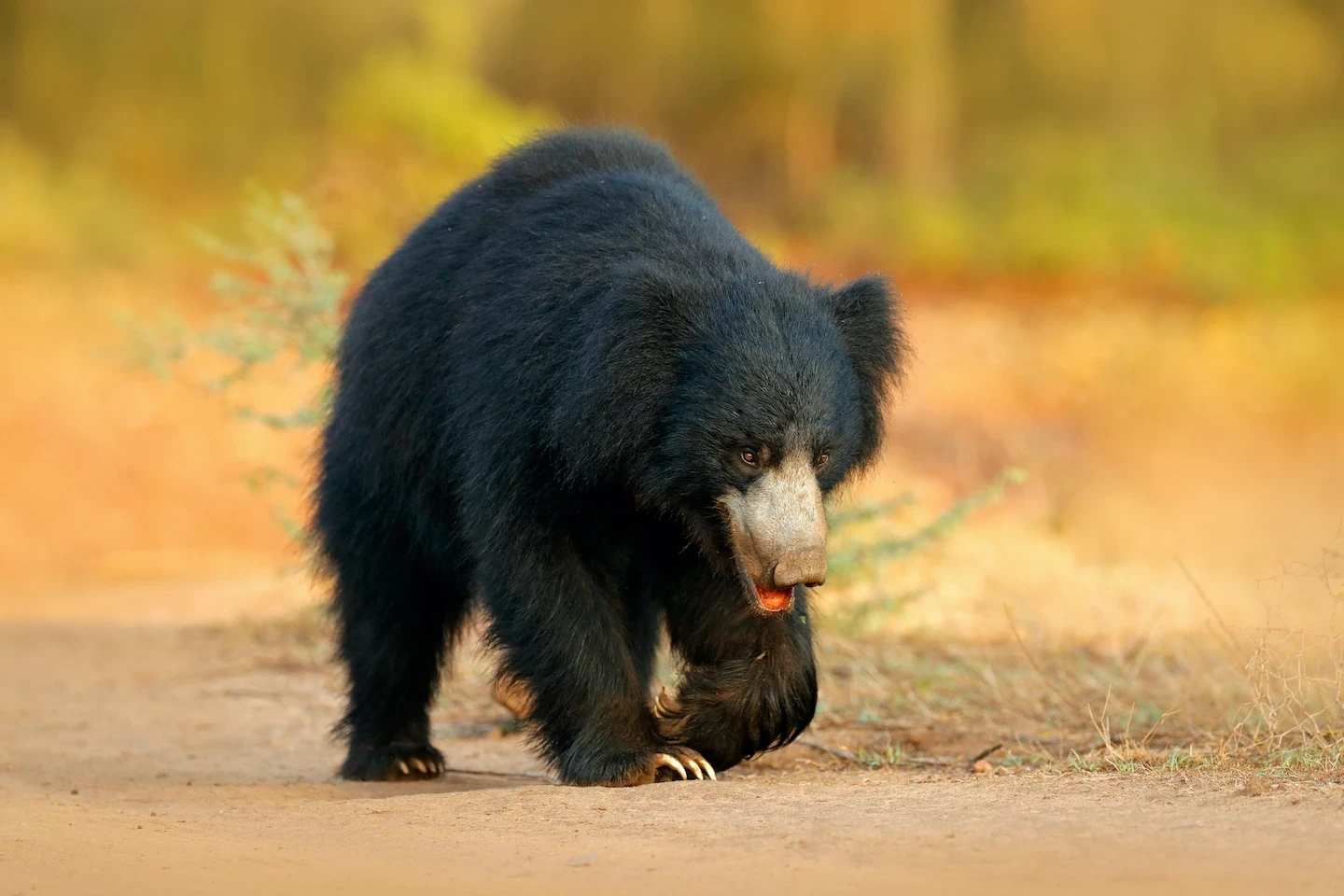
If gaurs reveal the forest's strength, sloth bears introduce a more elusive and unpredictable encounter.
India holds the vast majority of the world's sloth bear range, with the species inhabiting forests, scrublands and grasslands across the subcontinent. Recognisable by their shaggy black coats and long curved claws, these bears are specially adapted to feed on termites and ants, using their mobile snouts to suck insects from nests. The IUCN Red List classifies the sloth bear as Vulnerable, with habitat loss and human–bear conflict among its major threats.
On a guided safari through central India's forests, you might spot one foraging near a termite mound or moving through the undergrowth. Sightings are never guaranteed, but watching this distinctive bear in its natural habitat offers a wildlife encounter unlike any other.
How Many Days Do You Need?
Two to three days is a practical starting point for exploring Satpura's forests and wildlife. The reserve's main tourist season runs from mid-October to June, according to official Incredible India visitor information.
At a glance:
Signature species: Sloth bear
Primary destination: Satpura National Park
Recommended stay: 2–3 days
Best period: October–June
Other wildlife: Tiger, leopard, Indian gaur and deer
Experience: Guided jeep safaris and forest walks where permitted
Ideal for: Travellers seeking lesser-known mammals and distinctive wildlife behaviour
Sloth bears remain threatened by habitat loss and conflict with people. Protecting them means preserving the forests they depend on and making room for wildlife to coexist with nearby communities.
You may arrive hoping to spot this shaggy-coated bear, but the real reward is discovering one of India's most distinctive and often overlooked wild residents.
10. Wild Water Buffalo in India: Exploring the Wild Grasslands

Among India's most formidable wild animals, the wild water buffalo can weigh close to a tonne, with sweeping horns spanning over two metres. In Kaziranga's floodplains, you may spot herds grazing through tall grass or wading into wetlands. A guided safari offers a chance to witness these giants against a landscape shared with rhinos, elephants and other remarkable wildlife.
How Many Days Do You Need?
Two to three days is a practical starting point for exploring Kaziranga's main safari ranges. The best visiting season is generally November to April, with late February to early April particularly favourable for wildlife viewing, according to Assam Tourism.
At a glance:
Signature species: Wild water buffalo
Primary destination: Kaziranga National Park, Assam
Recommended stay: 2–3 days
Best period: November–April
Other wildlife: Greater one-horned rhinoceros, tiger, Asian elephant and swamp deer
Experience: Guided jeep safaris across grasslands and wetlands
Ideal for: Travellers seeking rare wildlife and distinctive wetland ecosystems
The wild water buffalo's future depends on protecting its habitat and maintaining healthy wild populations. Conservation efforts, including initiatives to recover the species in central India, highlight just how fragile its survival remains.
You may come for the sight of its sweeping horns against the grasslands, but leave understanding why protecting the wild water buffalo means protecting an entire landscape.
Wildlife Expeditions with IndiHorizons
Wildlife travel is not just about getting to a national park. It is about knowing where to go, when to go, how long to stay and what to look for once you get there.
At IndiHorizons, we design wildlife journeys across India, Nepal, Bhutan and Sri Lanka around that idea. From tiger tracking and red panda searches to blue whale expeditions and snow leopard encounters, our itineraries are built around immersive experiences rather than a checklist.
With 30+ years of on-ground expertise across the Indian subcontinent, our local teams bring destination knowledge, trusted relationships and the flexibility to shape each journey around the traveller.
Because sometimes the difference between seeing wildlife and experiencing it is knowing where to look.
Frequently Asked Questions
1. What are the best wildlife encounters in South Asia?
South Asia offers diverse wildlife experiences, from tiger and Asiatic lion safaris in India to red panda tracking in Nepal and Bhutan, blue whale watching in Sri Lanka, and snow leopard expeditions in Ladakh. You can also encounter Indian gaurs, sloth bears, Asian elephants and wild water buffaloes.
2. When is the best time to plan a wildlife trip to South Asia?
The best season depends on the species and destination. November to April is suitable for many Indian wildlife safaris and whale watching along Sri Lanka's southern coast. Snow leopard expeditions in Ladakh are best planned between January and March, while Sri Lanka's east coast generally offers whale-watching opportunities from May to September.
3. How much time should you plan for a wildlife encounter?
Allow 3–4 days per destination for most safari experiences, including multiple game drives. Elusive species such as red pandas and snow leopards may require 5–10 days, including trekking, acclimatisation and travel to remote habitats.
4. Where can you see South Asia's most iconic wildlife?
India's Gir landscape is the only wild home of Asiatic lions, while Kaziranga is renowned for one-horned rhinoceroses and wild water buffaloes. India's forests also offer opportunities to encounter tigers, elephants, gaurs and sloth bears. Red pandas inhabit the Eastern Himalayas, snow leopards roam Ladakh's high mountains, and Sri Lanka offers blue whale-watching excursions.
5. What should international travellers know before planning a wildlife trip to South Asia?
Plan your itinerary around seasonal access, park permits and realistic travel times between destinations. Book authorised guides, allow flexibility for wildlife sightings, and arrange appropriate travel insurance. For multi-destination trips, 10–14 days is a useful starting point for exploring one region, while combining several South Asian countries may require 2–3 weeks.
Ten Encounters. Ten Ways of Meeting the Wild.
Wildlife travel goes far beyond the classic African safari.
From tigers in India's forests and red pandas in the Himalayas to blue whales in the Indian Ocean and snow leopards in Ladakh, South Asia offers encounters as diverse as its landscapes.
Here, you're not just spotting wildlife. You're experiencing ten different worlds, each with its own story.
So keep the Masai Mara on your list. But leave room for South Asia, where the wild might surprise you in ways you never expected.