
Who Is the Kumari, Nepal’s Living Goddess?
Every country has its sacred rituals. Stories, beliefs and traditions that have travelled through generations and continue to hold a place in the spiritual life of its people.
Nepal has many of them.
But there is one tradition that feels almost impossible to explain in a single sentence.
You may have heard of the Kumari, Nepal’s living goddess. You may have seen her photographs — a young girl dressed in red, with kohl-rimmed eyes and an elaborate headdress, appearing from one of the beautifully carved windows of Kathmandu’s Kumari Ghar.
But who is she?
And how does a young girl come to be worshipped as a goddess?
The word Kumari comes from Sanskrit, where it refers to a young or unmarried girl. In Nepal, however, the word carries a much deeper meaning. The Kumari is a young girl believed to embody the divine feminine, particularly the goddess Taleju, and is revered as a living manifestation of the goddess.
What makes the tradition remarkable is not simply the belief itself. It is the fact that the goddess is not represented through a statue, painting or temple image.
She is believed to be present in a living child.
The Kumari lives in the heart of old Kathmandu, at Kumari Ghar in Kathmandu Durbar Square, surrounded by some of the valley’s most remarkable palaces, courtyards and temples. The house was built in 1757 under King Jaya Prakash Malla and remains the traditional residence of Kathmandu Kumari.
And this is where the story becomes fascinating.
The Kumari tradition sits at the intersection of Hinduism, Buddhism, Newar culture and Nepal’s royal history. The Kathmandu Kumari is selected from a Buddhist Shakya family, yet she is revered by both Hindus and Buddhists. The tradition itself is deeply connected to the worship of Taleju Bhawani, the tutelary goddess associated with the Malla rulers.
So, how did all of this begin?
The answer takes us back several centuries, to the time of the Malla kings and a goddess who, according to legend, once visited the royal palace herself.
And that is where the story of the Kumari begins.
The Story Begins With a Goddess and a King

Long before the Kumari became a familiar face in the heart of Kathmandu, there was a goddess, a king and a story that has been passed down through generations.
The goddess was Taleju Bhawani, the powerful deity associated with the Malla rulers of the Kathmandu Valley. The king was Jaya Prakash Malla, remembered as the last Malla king of Kathmandu. And according to the traditional legend, the two shared something that was far beyond an ordinary royal relationship.
Taleju would visit the king at night.
She would appear in human form and spend time with him, traditionally said to be playing a game of dice while discussing matters concerning the kingdom. It was a private meeting, one that came with a very clear condition: the king was never to reveal that the goddess visited him.
For a time, the secret remained between them.
Until it didn't.
There are several versions of what happened next. One traditional account says that the queen became suspicious and eventually looked into the room where the king was meeting Taleju. Another version says that the king himself became overwhelmed by the goddess's beauty and broke the boundary of their relationship. In both versions, however, the ending is much the same.
Taleju was angered.
She disappeared from the palace and refused to return.
For the king, this was not simply the loss of a divine visitor. Taleju was deeply connected to the spiritual and political life of the Malla court, and her disappearance was understood as a serious rupture between the ruler and the goddess. According to the traditional account preserved by the Nepal Tourism Board, Jaya Prakash Malla pleaded for her forgiveness.
Eventually, Taleju appeared to him in a dream.
But she would not return to the palace in the same way.
Instead, the king was instructed to find a young virgin girl in whom the goddess would reside, allowing the people to continue worshipping her.
And this is where the legend of the Kumari begins to become the living tradition we recognise today.
The goddess would no longer arrive at the palace herself.
She would arrive as a child.
The legend offers a traditional explanation for the Kumari's origins. Over time, the belief developed into an established religious institution, with selection customs and rituals that continue in Kathmandu today.
The tradition was institutionalised during the Malla period, and the connection between the Kumari and the old royal city remains visible even today. Kumari Ghar, the residence of the Kathmandu Kumari, stands within Kathmandu Durbar Square, surrounded by the palaces, temples and courtyards that once formed the centre of Malla power.
But the legend leaves us with a much bigger question.
If the goddess was to live inside a human child, how would that child be found?
And what would make one young girl worthy of becoming the Kumari?
That is where the story takes an extraordinary turn.
How Is the Kumari Chosen?
Becoming the Kumari is not simply a matter of choosing a young girl and giving her a sacred title.
The selection follows longstanding Newar religious customs, with traditional physical criteria and ritual practices playing a central role. Accounts of the process vary, so individual customs should be described only where reliable sources document them.
What does the selection involve?
The Shakya lineage: The Kathmandu Kumari is traditionally selected from the Shakya Buddhist community of the Kathmandu Valley. The Nepal Tourism Board’s overview of the Kumari tradition provides background on the institution.
The 32 lakshanas: Traditional accounts describe 32 auspicious physical characteristics used to assess candidates. These include features associated with the eyes, teeth, voice, hands and feet.
Composure and ritual practices: Traditional accounts describe expectations of composure and ritual elements in the selection process. However, specific tests and customs are not consistently documented. Former Royal Kumari Rashmila Shakya disputed the widely repeated story that candidates must face 108 severed buffalo heads.
Once the selection is complete, the girl is installed as the Kumari and moves into Kumari Ghar in Kathmandu Durbar Square, the historic residence built by King Jaya Prakash Malla in 1757. From that point onward, her childhood takes on an extraordinary new rhythm: devotees seek her blessing, religious traditions shape her daily life, and her public appearances become closely connected with some of Kathmandu's most important festivals.
Which brings us to perhaps the most human question in the story: what is it actually like to grow up as a living goddess?
A Life Between Childhood and the Divine

Once selected, the Kumari moves into Kumari Ghar, the historic residence on Kathmandu Durbar Square. Her life is structured around religious duties and traditions rather than the routines of an ordinary life. Devotees come to receive her darshan, and her public appearances are generally connected to important religious occasions and festivals.
For much of her tenure, she remains within the residence, appearing at particular moments for devotees. During Indra Jatra, however, she leaves Kumari Ghar as part of the celebrated chariot procession through Kathmandu's historic centre. The festival is one of the most important occasions for seeing the Kumari outside her usual setting.
The Kumari tradition continues within a changing Nepal, where centuries-old religious practices remain an important part of contemporary cultural life. The Kumari is simultaneously a child, a revered religious figure and a living part of Kathmandu’s cultural heritage.
The Kumari and Indra Jatra: When Kathmandu Comes Alive
If there is one moment when the Kumari tradition becomes impossible to miss, it is during Indra Jatra, Kathmandu's spectacular annual festival dedicated to Indra, the Hindu god of rain and the king of heaven. Held in the historic Kathmandu Durbar Square and surrounding neighbourhoods, the festival brings together centuries-old Newar rituals, music, masked dances and processions.
At the centre of some of these celebrations is the Kumari.
During the festival, she is carried through the old city in her chariot, allowing devotees to receive her darshan outside the walls of Kumari Ghar. The procession moves through streets that were once part of the Malla royal city, turning Kathmandu's historic centre into a space of celebration and worship.
Some of the most distinctive elements of Indra Jatra include:
Kumari's chariot procession through the historic city
Masked dances depicting deities and mythological figures
Traditional music and Newar rituals
The ceremonial display of Yosin, a sacred wooden pole associated with the festival
Thousands of devotees gathering around the procession
What makes the festival particularly fascinating is the way religion, history and community come together in the same streets. The grand squares and ancient courtyards are not simply heritage sites during Indra Jatra; they become active spaces of worship.
For visitors, it offers a different way of experiencing Kathmandu. Instead of encountering the city's heritage as something static, you see it being lived, in its music, rituals, processions and communities.
And at the heart of it all is the Kumari: a young girl who, for the duration of her sacred role, becomes one of the most important living symbols of Kathmandu's spiritual heritage.
Life After the Kumari Role
The Kumari's role is extraordinary, but it is not permanent. Traditionally, her first menstruation marks the end of her tenure, reflecting the ritual beliefs associated with the institution. The transition signals the beginning of a new chapter in her life, while the selection process begins again for her successor.
This is one of the most striking parts of the tradition because the transformation works in both directions. A girl who has spent years being treated as a divine presence must eventually return to a life that is, in many ways, completely ordinary.
The transition can be understood through a few key points:
The role is temporary: A Kumari traditionally serves only during childhood.
Puberty marks the end: Menstruation is traditionally regarded as the point at which she leaves the role.
A successor is selected: Another eligible girl undergoes the traditional selection process.
The former Kumari returns home: She returns to family life and adjusts to everyday routines outside the institution.
For generations, the tradition has continued through a succession of young girls, each serving as the Kumari for a part of her childhood. But while the religious role follows an established cycle, life after it is deeply personal.
A former Kumari returns to family life, with new routines, educational opportunities and greater independence to navigate. Each girl's experience is different, shaped by her circumstances and the support available to her.
The transition marks the end of her time as the living goddess, but not the end of the tradition's significance. The Kumari remains an enduring part of Nepal's spiritual heritage, even as the lives of the girls who serve in the role move forward.
Visiting the Kumari: What Travellers Should Know
If you want to encounter the Kumari during a visit to Kathmandu, start at Kumari Ghar in Kathmandu Durbar Square, in the heart of the old city. Visitors may occasionally glimpse the Kumari at a window of Kumari Ghar, but no reliable daily appearance time is guaranteed. Plan your visit around Kathmandu Durbar Square and its heritage sites rather than making the sighting the sole purpose of your visit.
Entry to Kathmandu Durbar Square is subject to the applicable heritage-site admission fee. Check the Nepal Tourism Board’s official heritage-site entry-fee information for the current rate applicable to your visitor category before travelling.
A few things are worth keeping in mind:
Do not expect a private meeting. The traditional encounter is brief and public.
Photography: Follow the current photography rules posted at Kumari Ghar and the instructions of local authorities.
Dress respectfully, particularly around the religious spaces of Durbar Square.
Do not treat the visit like a performance. The Kumari is a living religious figure, not a cultural show staged for visitors.
If you want to see the tradition at its most public, Indra Jatra is the key festival, when the Kumari takes part in the famous chariot procession through Kathmandu.
The best way to approach the experience is simple: observe quietly, follow local instructions and remember that you are entering a place of worship as much as a heritage site.
The Kumari in Modern Nepal: An Ancient Tradition in a Changing City

Kathmandu is a city where the past does not politely stay in the past. You can walk through a centuries-old courtyard in the morning, pass a temple where devotees are still offering prayers, and then step into the noise and movement of modern Kathmandu a few minutes later. Somewhere within that contrast, the Kumari continue to live.
That is perhaps what makes the tradition so fascinating today. The Kumari is not a figure recreated for tourists or a ritual performed only on special occasions. She remains part of the living religious and cultural landscape of the Kathmandu Valley, particularly within Newar communities. Her story continues through the same city where the Malla kings once ruled and where the worship of Taleju became deeply connected with royal life.
The tradition also reflects the long-standing relationship between Hindu and Buddhist religious practices in the Kathmandu Valley, where the Kumari continues to hold significance for devotees across both communities.
For travellers, the Kumari tradition offers a glimpse of Kathmandu's living heritage: religious practices, community identity and centuries-old customs that remain part of the city's present. It is a tradition best understood not simply through its history, but through the people and beliefs that continue to sustain it.
That continuity is what makes Kathmandu so compelling. Its heritage is not confined to monuments, museums or ruins. It can be found in rituals that are still practised, festivals that still fill its streets and traditions that continue to give meaning to ordinary spaces.
Frequently Asked Questions About the Kumari
1. Who is the Kumari, the living goddess of Nepal?
The Kumari is a young girl traditionally selected from the Shakya clan of the Newar Buddhist community and revered as a living manifestation of the goddess Taleju. The Kathmandu Kumari is the most prominent Kumari in Nepal.
2. How is the Kumari chosen?
The selection follows traditional criteria that include the 32 lakshanas, physical characteristics and religious rituals. The precise practices should be understood through documented accounts of the selection process.
3. Why is the Kumari called a living goddess?
The Kumari is believed to embody the divine feminine in human form and is traditionally associated with Taleju Bhawani. Devotees visit her to receive darshan, or a sacred viewing and blessing.
4. Can tourists visit the Kumari in Kathmandu?
Visitors can visit Kumari Ghar in Kathmandu Durbar Square and may sometimes see the Kumari at one of the building's windows, although an appearance is not guaranteed. Visitors should follow local rules and approach the tradition respectfully.
5. What happens when the Kumari reaches puberty?
The Kumari traditionally leaves her role when menstruation begins. A successor is then selected, and the former Kumari returns to life outside the institution, although individual experiences differ.
The Living Goddess, and the Story That Continues
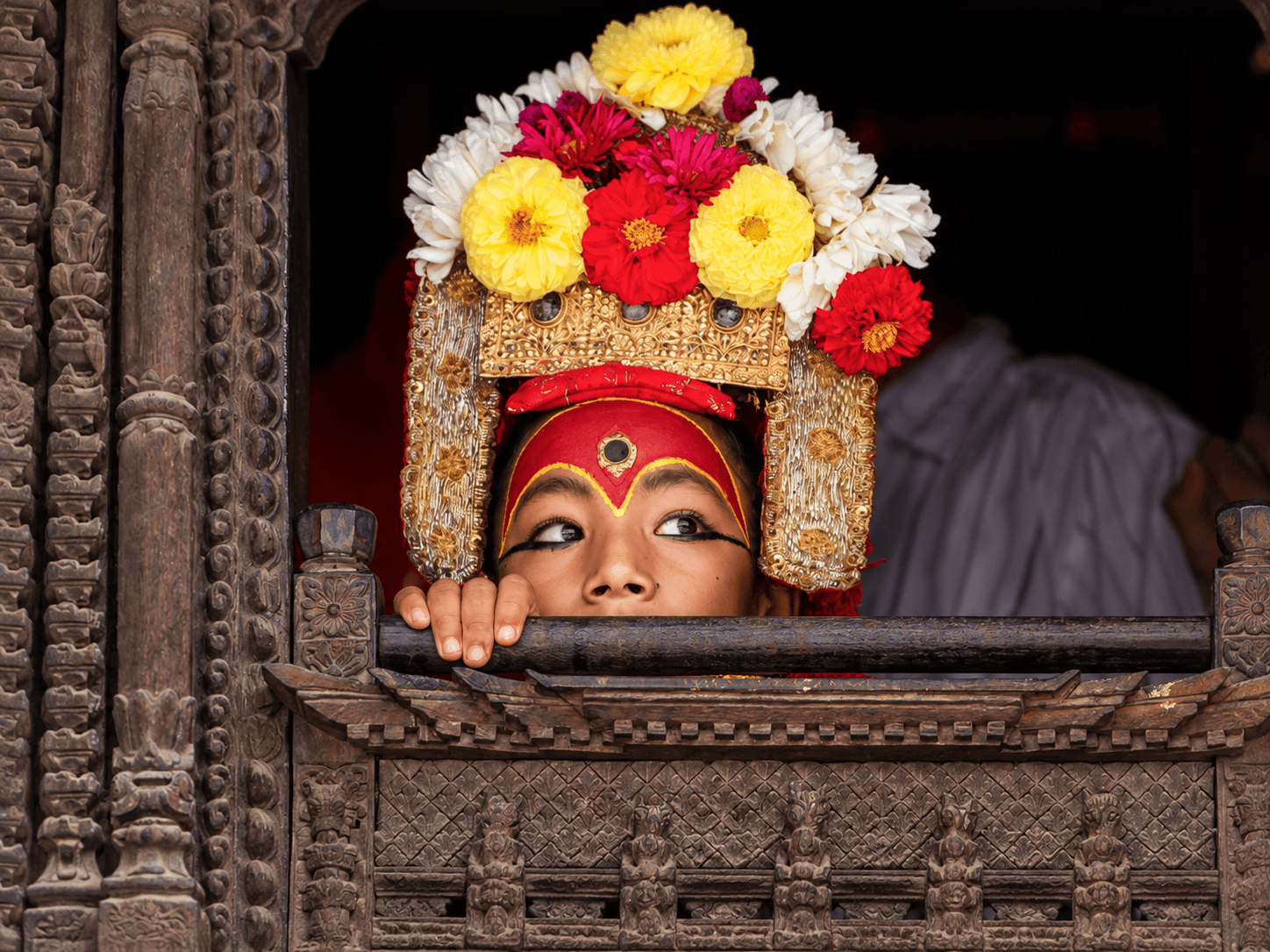
Perhaps what makes the Kumari so fascinating is that she cannot be placed neatly in the past.
She belongs to the stories of the Malla kings, to the courtyards and temples of old Kathmandu, to the worship of Taleju and to centuries of Newar tradition. Yet she also belongs to the Kathmandu of today, where devotees still wait for her darshan, festivals still fill the ancient streets and a new girl continues to take her place when another leaves.
To encounter the Kumari is therefore to encounter something more than a religious tradition. It is to see how faith, history and living culture can exist within the same city, passed from one generation to the next without becoming a museum piece.
And perhaps that is the most beautiful part of Nepal's living goddess: the story is still being written.
Experience Nepal Beyond the Familiar
Discover Nepal's living traditions, historic neighbourhoods and cultural encounters with IndiHorizons.
→ Explore Nepal with IndiHorizons